 Introduction
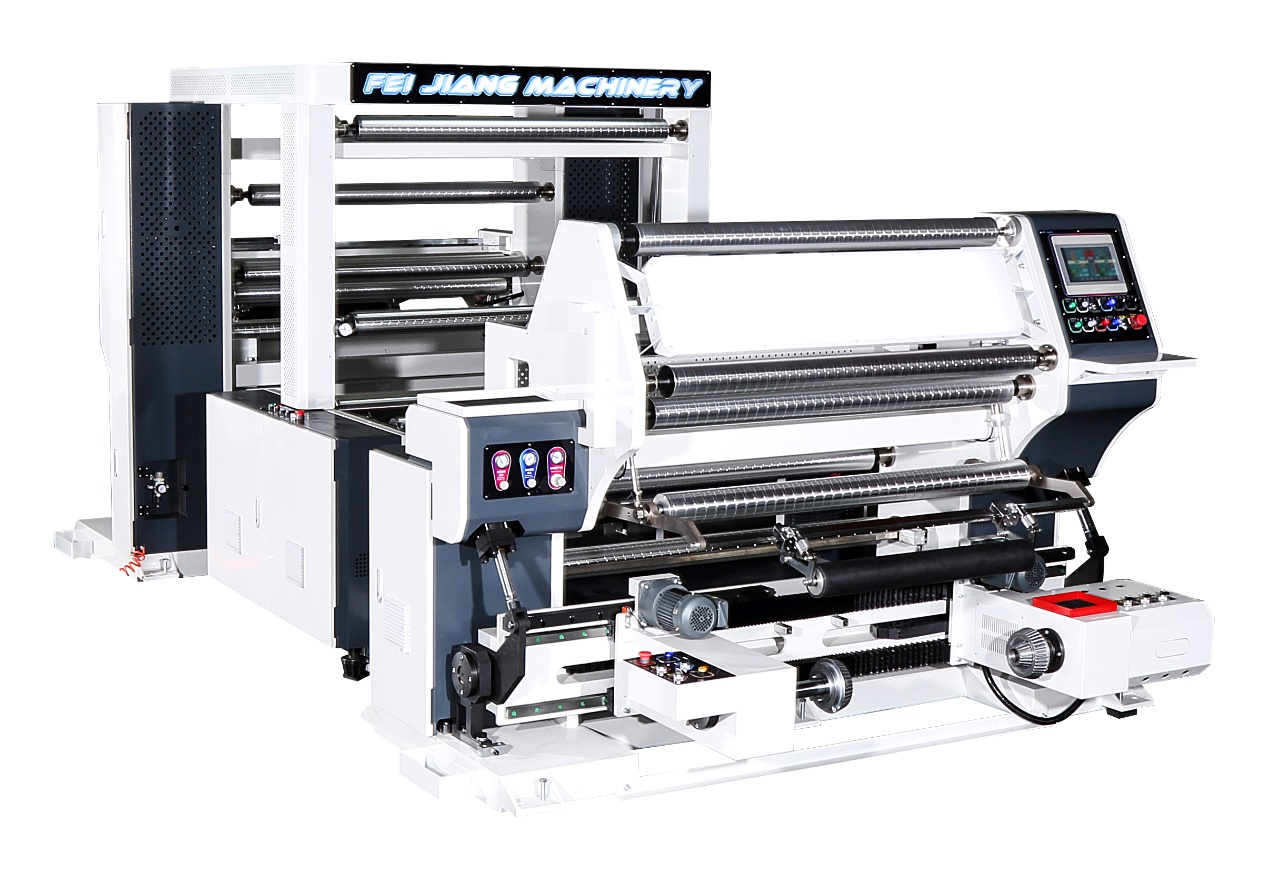
The Feijiang FPR series rewinder is a professional multi-functional rewinder (with optional functions position such as double side code printing, inspection, corona.)
The device operating system adopts a three servo structure. The supporting fully automatic tension system for unwinding and rewinding is located on both sides of the equipment.
Both unwinding and rewinding adopt a shaftless form, which can quickly move materials up and down, reducing operational intensity.
The equipment can be quickly installed with an integral steel plate base, which only needs to be adjusted horizontally without any additional foundation requirements.
Equipment parameters
Main data
Material type: PET PVC BOPP and other composite film products
Material thickness: 12-120u (thin film type)
Equipment tension: 40-220N (diameter 800mm)
Material width: 500-1250mm
Equipment speed: max 300m/min
Communication protocol: EtherCAT
Unwinding data
Unwinding diameter: max 800mm
Unwinding weight: max 500kg
Reel core: paper tube
Adapted tube core: 3, 6 inches
Unwinding width: 500-1250mm
Unwinding brake: 5.5KW bus type servo motor
Unwinding tension: fully automatic/taper
Tension detection: BOSEN
Support movement: motor
Web Correction data
Correction brand: BST
Correction probe: CCD head
Deviation correction stroke: ± 100mm
Response speed: 10mm/S
Transmission data
Main motor power: 2.9KW bus type servo motor
Roll up data
Winding diameter: max 800mm
Winding weight: max 500kg
Reeling tube core: paper tube
Adapted tube core: 3, 6 inches
Winding width: 600-1250mm
Winding brake: 5.5KW bus type servo motor
Winding tension: fully automatic/taper
Tension detection: BOSEN
Support movement: motor
Design form: (according to the actual needs of the customer)
Operation plane: Right side (facing the winding end)
Material guide roller: aluminum roller (oxidation)
Main transmission roller: steel roller
Main pressure roller: rubber roller
Reeling and pressing roller: rubber
Noise level
Noise value: ≤ 78 dB (excluding the blowing mechanism, 1 meter away from the equipment)
Device Color
Main color: white
Panel color: black
Equipment energy consumption
Voltage: 380V ± 10% 3-phase
Frequency: 50Hz
Power: 116KW
Air pressure: ≥ 6 KG
Gas consumption: 2 m ³/ H
Installation conditions
Altitude: 1000m
Relative humidity: 70% non condensing
Environmental temperature: 45 ℃ max
Device Description
1-1. Unwinding position
The hydraulic shaftless winding system is supported by a movable support and adopts pneumatic locking. The movable support is installed on the linear guide roller as a whole, and the width is adjusted by motor movement
One servo motor is equipped for unwinding, and one set of tension sensor is used to generate appropriate tension for unwinding through PLC calculation
Equipped with an automatic deviation correction system, it tracks the edges of materials or the printing lines of materials. The photoelectric bracket is manually moved and locked. Equipped with CCD independent control selection interface
Equipped with 1 manual deviation adjustment guide roller, used when there is uneven material on both sides
1 set of supporting pneumatic negative pressure pressure roller, made of rubber
Material passing method: equipped with a gantry type material passing frame
Corona treatment: Reserve a corona workstation (specific size depends on the brand ordered by the customer)
1-2. Transmission position
The main transmission roller is made of steel roller material, and the transmission method adopts synchronous wheel and synchronous belt
The main pressure roller adopts pneumatic control, which effectively blocks the tension of unwinding and rewinding
One servo motor is used as the main driving force
1-3. Printing station
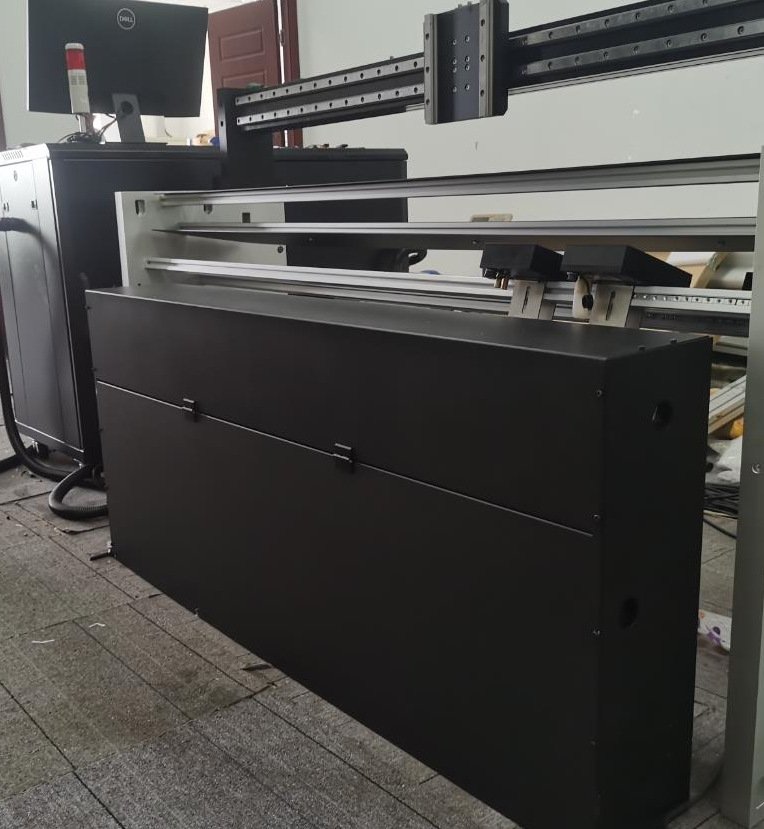
Reserve installation positions for positive and negative spray codes, protect and solidify lampshades
Reserved installation position for positive and negative detection
1-4. Reeling mode
The hydraulic shaftless down coiling system is supported by a movable support and pneumatically locked. Mobile support overall
Installed on a linear guide rail, using a motor to move and adjust the width
1 set of servo motor for winding and 1 set of tension sensor for winding. Through PLC calculation, the motor generates winding
Appropriate tension of the roll
1 set of supporting pneumatic negative pressure pressure roller, made of hard rubber
2-1. Main control (PLC)
All main control modules are connected to the main control unit through PLC
The main control mode is connected through network cables, ensuring orderly and stable internal wiring of the equipment as a whole
The main functions of PLC calculation
Inertia compensation function
Friction compensation function
Diameter calculation function
Tension curve function
Acceleration and deceleration setting function
Length, meter, diameter display function
Motor control synchronous steady-state operation function
2-2. Human machine interaction
Equipped with a 10 inch human-machine interactive touch screen at the equipment winding end
Main functions:
Real time dynamic display of device operation
Related parameter settings
Related operation settings
Alarm function
Remote IOT service function, which can be remotely maintained, adjusted, and improved interaction between customers and manufacturers
2-3. Transmission Technology
The main motor is equipped with a rotary encoder, and the servo adopts vector control mode, using synchronous wheels and synchronous belt transmission
Move. By controlling the closed-loop speed of the main drive, the operating speed of the equipment is stable and reliable.
The winding tension is controlled in real-time through torque. The winding speed is controlled by vector to achieve steady-state winding.

